What Is a Truck Mounted Attenuator (TMA)?
TL-2 & TL-3 TMA Vehicles and Traffic Management in Abu Dhabi
A Truck Mounted Attenuator (TMA) is an energy-absorbing crash protection system installed on a suitable vehicle to help reduce the severity of certain rear-end collisions.
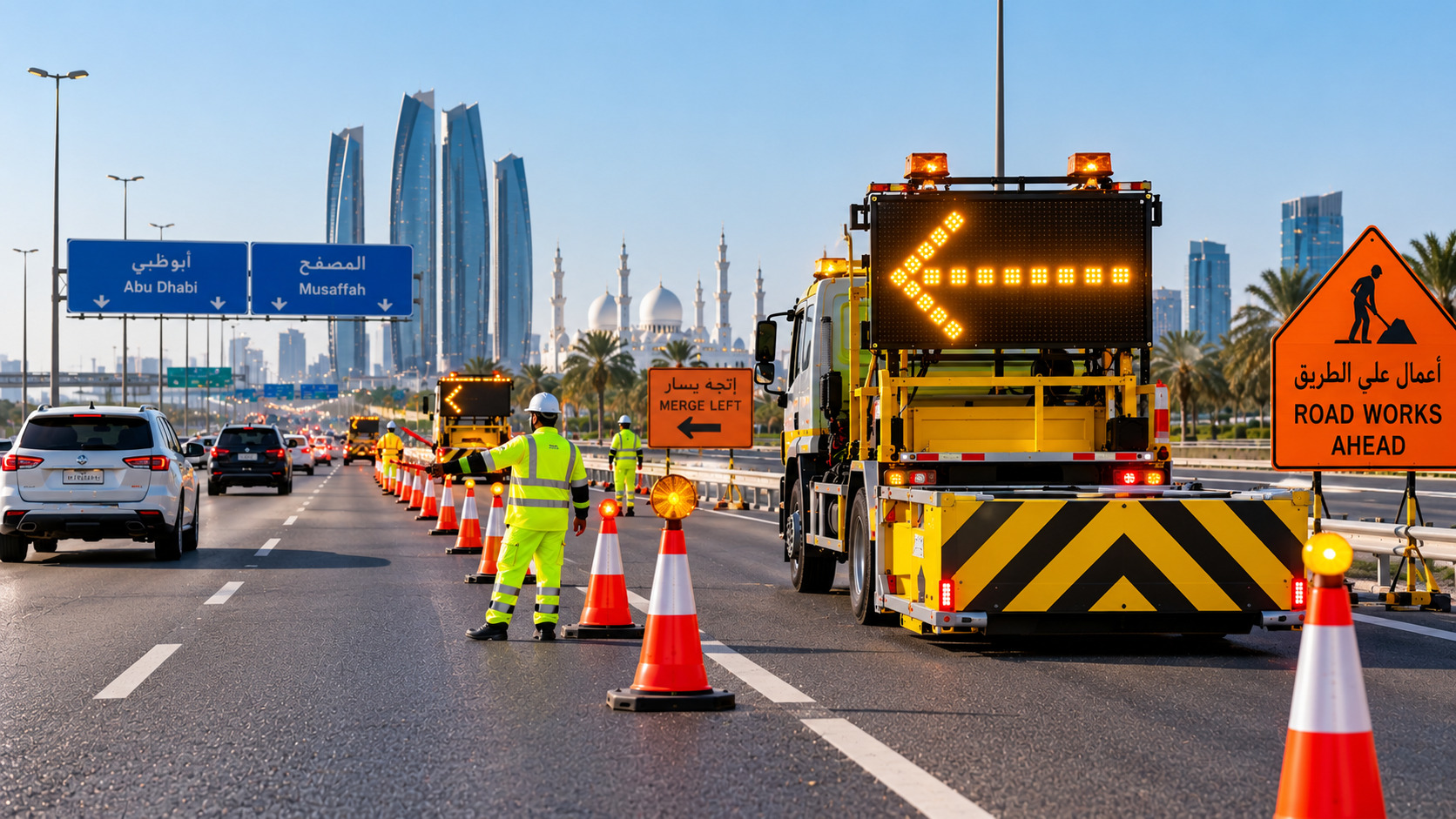
TMA vehicles are commonly deployed at temporary roadwork locations to provide additional protection for personnel, equipment and work activities.
Common applications include:
• Temporary lane closures and road diversions
• Highway maintenance and repair works
• Infrastructure and utility installation
• Road marking and resurfacing activities
• Mobile and short-duration roadworks
• Night-time construction operations
• Emergency road maintenance and traffic management
TMA vehicles are often equipped with illuminated arrow boards, warning lights and high-visibility safety markings to improve their visibility to approaching motorists.
Understanding TL-2 and TL-3 TMA Vehicles
TMA systems are evaluated under recognized crash-testing standards, including the Manual for Assessing Safety Hardware (MASH).
Two commonly used classifications are Test Level 2 (TL-2) and Test Level 3 (TL-3).
TL-2 Truck Mounted Attenuator
TL-2 equipment is evaluated using crash-test conditions involving impact speeds of approximately 70 km/h.
TL-2 TMA vehicles may be suitable for certain temporary traffic management applications, depending on the roadway conditions, approved traffic management plan and project-specific safety requirements.
Typical applications may include:
• Suitable urban road maintenance activities
• Temporary work zones on lower-speed roads
• Utility maintenance and installation activities
• Short-duration roadworks
• Traffic management arrangements approved for TL-2 deployment
TL-3 Truck Mounted Attenuator
TL-3 equipment is evaluated under higher impact-speed crash-testing conditions, including approximately 100 km/h.
TL-3 TMA vehicles are commonly considered for more demanding traffic management operations where higher-impact protection is required.
Typical applications may include:
• Major highway maintenance works
• High-speed road infrastructure projects
• Expressway lane closures
• Certain mobile roadwork operations
• Highway utility and maintenance activities
• Projects requiring TL-3 protection under an approved traffic management arrangement
1. TL-2 TMA Vehicle
- Crash-Test Level: Test Level 2 (TL-2).
- Approximate Impact Test Speed: 70 km/h.
- Protection Classification: Lower crash-test level.
- Typical Applications: Suitable for certain lower-speed roadworks, urban road maintenance and temporary traffic management operations.
- Deployment Requirements: Requires an approved traffic management plan and site-specific risk assessment.
2. TL-3 TMA Vehicle
- Crash-Test Level: Test Level 3 (TL-3).
- Approximate Impact Test Speed: 100 km/h.
- Protection Classification: Higher crash-test level.
- Typical Applications: Considered for more demanding highway operations, major road maintenance and higher-speed traffic environments.
- Deployment Requirements: Requires an approved traffic management plan and site-specific risk assessment.
Important: TL-2 and TL-3 ratings refer to controlled crash-test performance, not automatic authorization to operate at particular posted road speed limits. Final TMA selection must comply with the relevant authority requirements, equipment specifications, approved traffic management drawings and site-specific risk assessment.
Why Are TMA Vehicles Important for Road Safety?
Roadwork environments expose workers and equipment to moving traffic. Unexpected lane changes, driver distraction and reduced visibility can increase the risk of vehicle collisions near work zones.
Properly positioned TMA vehicles form part of a broader temporary traffic management system designed to reduce these risks.
1. Work-Zone Protection
TMA systems help absorb energy in certain rear-end impacts, providing an additional protective measure for roadwork operations.
2. Improved Traffic Guidance
Illuminated arrow boards, flashing warning lights and high-visibility markings help alert approaching motorists to temporary changes in traffic conditions.
3. Support for Temporary Lane Closures
TMA vehicles can form part of approved arrangements for lane closures, temporary diversions and maintenance activities.
4. Safer Night-Time Operations
TMA vehicles equipped with appropriate warning systems can improve work-zone visibility during nighttime operations and reduced-light conditions.
5. Support for Mobile Roadworks
Certain TMA configurations can be used in moving traffic management operations, subject to approved procedures and applicable safety requirements.
TMA Vehicles with Full Traffic Management Teams
Effective temporary traffic management requires more than the deployment of a TMA vehicle.
Depending on the project, contractors may require a complete traffic management arrangement incorporating manpower, equipment, supervision and temporary road safety devices.
Road Shield Solutions provides services that can include:
• TL-2 and TL-3 TMA vehicle deployment
• TMA vehicles with operators
• Full traffic management teams
• Temporary traffic signs and traffic cones
• Illuminated arrow boards and warning systems
• Lane closure installation and removal
• On-site supervision and coordination
• Traffic management equipment monitoring
• Mobilization and demobilization services
The required number and classification of TMA vehicles, together with the associated manpower and equipment, are determined according to the approved traffic management plan and project scope.
Traffic Diversion Drawings and ITC Permit Coordination in Abu Dhabi
Temporary road closures and traffic diversions in Abu Dhabi require appropriate planning and relevant authority approvals.
Contractors undertaking work that affects traffic movement must follow the applicable requirements of Abu Dhabi Mobility, the Integrated Transport Centre (ITC), and other relevant authorities.
Traffic management planning and coordination services can include:
• Traffic Management Plan (TMP): Preparation of traffic management arrangements based on project requirements.
• Traffic Diversion Drawings (TDD): Development of temporary traffic diversion layouts.
• Method Statements and Risk Assessments (MSRA): Identification of operational procedures, potential risks and appropriate control measures.
• Permit Coordination: Preparation and coordination of applicable traffic diversion permit submissions.
• Traffic Management Deployment: Implementation of approved traffic control arrangements.
• Inspection and Maintenance: Monitoring the temporary traffic management setup during the work period.
All activities must be conducted in accordance with the applicable approvals, permit conditions and authorized working schedules.
Night-Time Highway Traffic Management in Abu Dhabi
Night-time operations are frequently required for highway maintenance, utility works, bridge maintenance and other infrastructure activities.
Working at night can help reduce disruption to daytime traffic, but it also introduces additional considerations such as reduced visibility, driver fatigue and changes in traffic conditions.
Professional night-time traffic management should include:
• Suitable TL-2 or TL-3 TMA vehicles as required
• Properly positioned temporary traffic signs
• Reflective cones and warning devices
• Adequate visibility and warning lighting
• Trained traffic management personnel
• Approved lane closure and diversion arrangements
• Continuous supervision and site monitoring
All night operations should follow the approved traffic management drawings and relevant authority permit conditions.
How to Select the Right TMA Vehicle for Your Project
Selecting the appropriate TMA classification requires consideration of several important factors.
• Road classification and traffic conditions: Understand the roadway type, operating speeds and traffic characteristics.
• Nature of work: Identify whether the activity involves a stationary work zone, temporary lane closure, mobile operation or emergency maintenance.
• Project duration: Consider whether TMA protection is required for a single shift, multiple nights or an extended project period.
• Site risk assessment: Review visibility, traffic exposure, work-zone geometry, access arrangements and potential collision risks.
• Authority requirements: Confirm the required TMA test level, vehicle configuration and deployment arrangement against the approved drawings and permit conditions.
• Traffic management support: Determine whether the project requires a TMA vehicle only or a complete traffic management team with additional equipment.
An appropriate TMA arrangement should always be selected through proper planning rather than solely on the basis of availability or cost.
Professional TMA & Traffic Management Services in Abu Dhabi
Road Shield Solutions L.L.C – S.P.C is an Abu Dhabi-based temporary traffic management specialist supporting construction, infrastructure, utility and highway maintenance projects.
Our services include MASH TL-2 and TL-3 TMA vehicles, temporary lane closures, traffic diversion planning, full traffic management teams and permit coordination.
We support clients across Abu Dhabi, Al Ain, Al Dhafra and other locations in the UAE, providing traffic management arrangements tailored to project requirements and applicable authority approvals.